Rules and Bye-laws
The Sabai's constitution, correct as at June 2025. It governs who may join, how the Sabai is run, what its money may be spent on, and how these rules may themselves be changed. Applications for membership and for assistance are made on its terms.
Rules 1–2. Name, address and objects
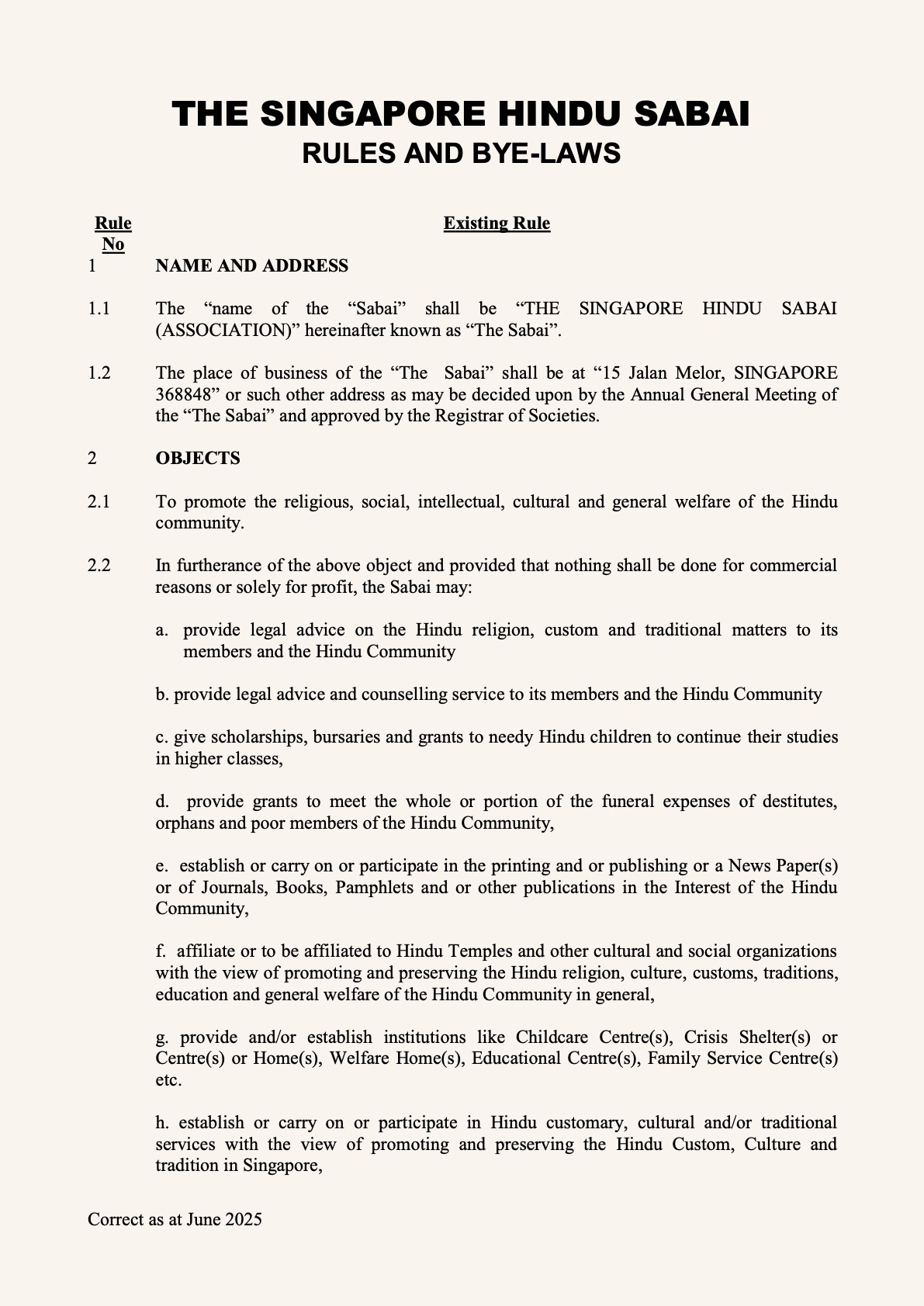
The society is “The Singapore Hindu Sabai (Association)”, with its place of business at 15 Jalan Melor, Singapore 368848. Its object is to promote the religious, social, intellectual, cultural and general welfare of the Hindu community, and Rule 2.2 lists ten things it may do in furtherance of that — provided nothing is done for commercial reasons or solely for profit.
The objects in fullRules 3–5. Membership
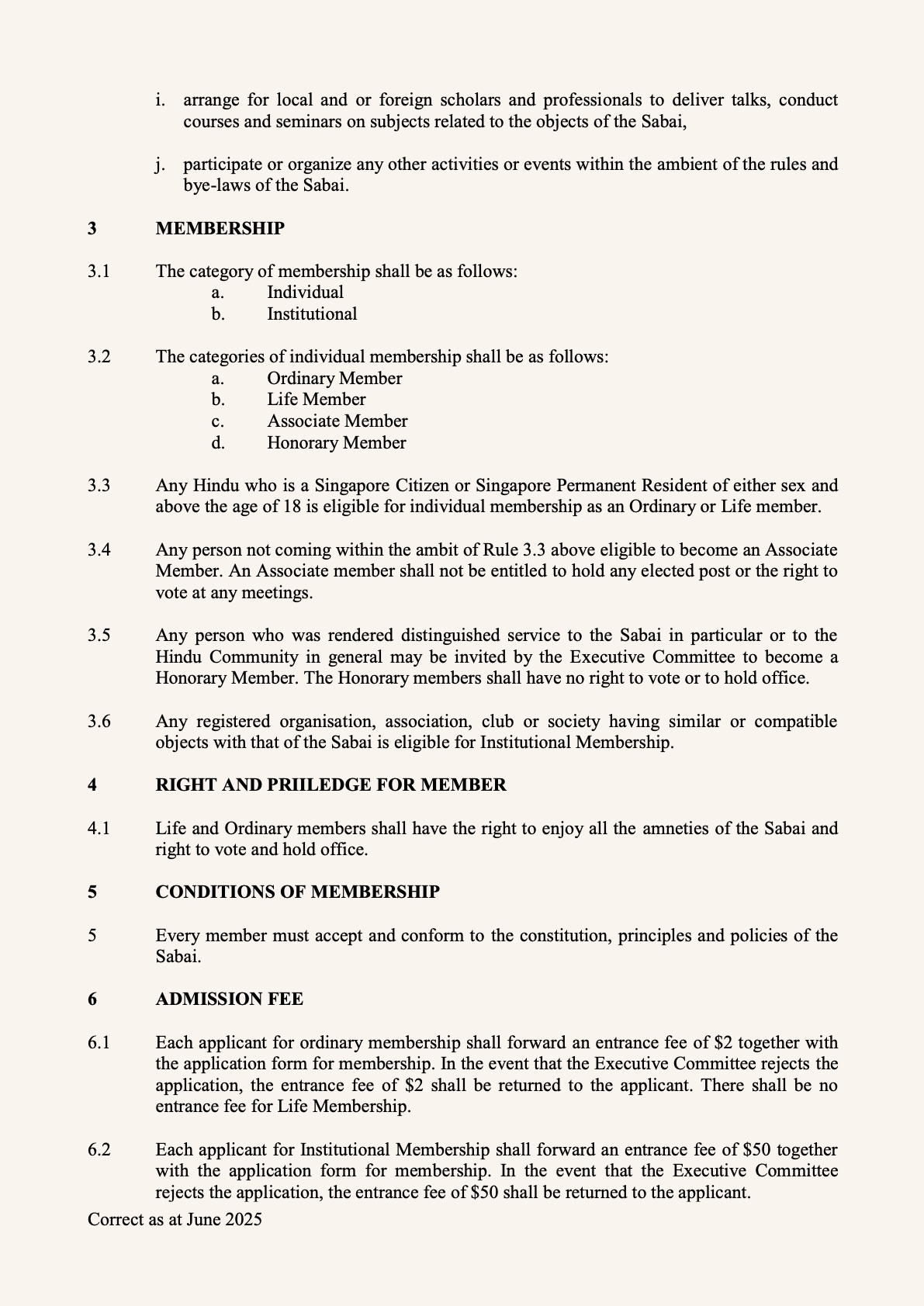
Membership is individual or institutional. Individual membership is Ordinary, Life, Associate or Honorary. Any Hindu who is a Singapore citizen or permanent resident, of either sex and above the age of eighteen, is eligible as an Ordinary or Life member. Anyone falling outside that may become an Associate member, without the right to vote or hold office. Honorary membership is by invitation of the Executive Committee, for distinguished service, and likewise carries no vote. Any registered organisation with compatible objects may take Institutional membership. Every member must accept and conform to the constitution, principles and policies of the Sabai.
Rules 6–8. Fees and admission
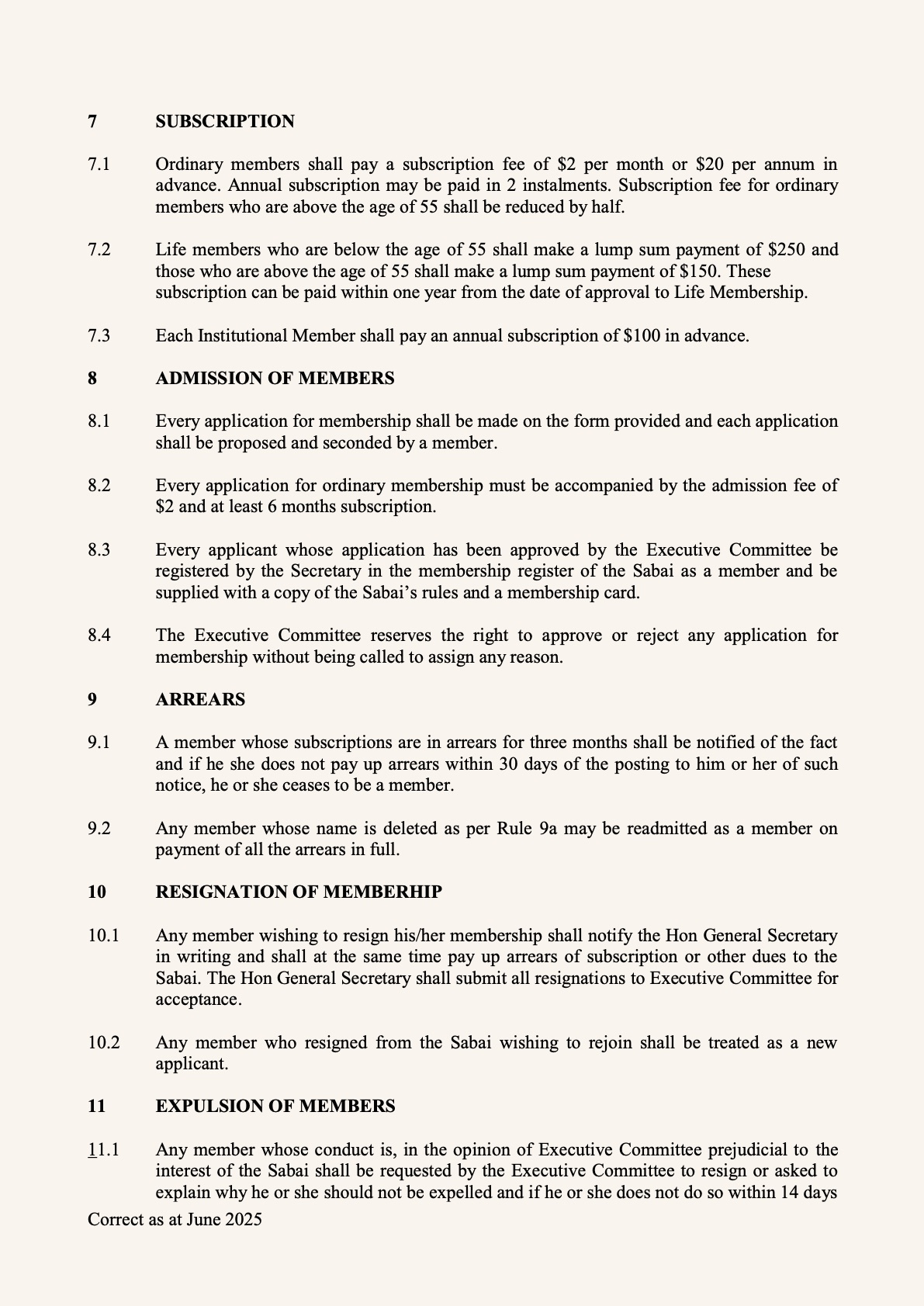
An Ordinary membership application carries a $2 entrance fee; an Institutional application, $50. Both are returned if the Executive Committee rejects the application. There is no entrance fee for Life membership. Every application is made on the Sabai's form and must be proposed and seconded by a member, and an Ordinary application must arrive with the entrance fee and at least six months' subscription. The committee may approve or reject any application without giving a reason.
Fees in detailRules 9–11. Arrears, resignation and expulsion
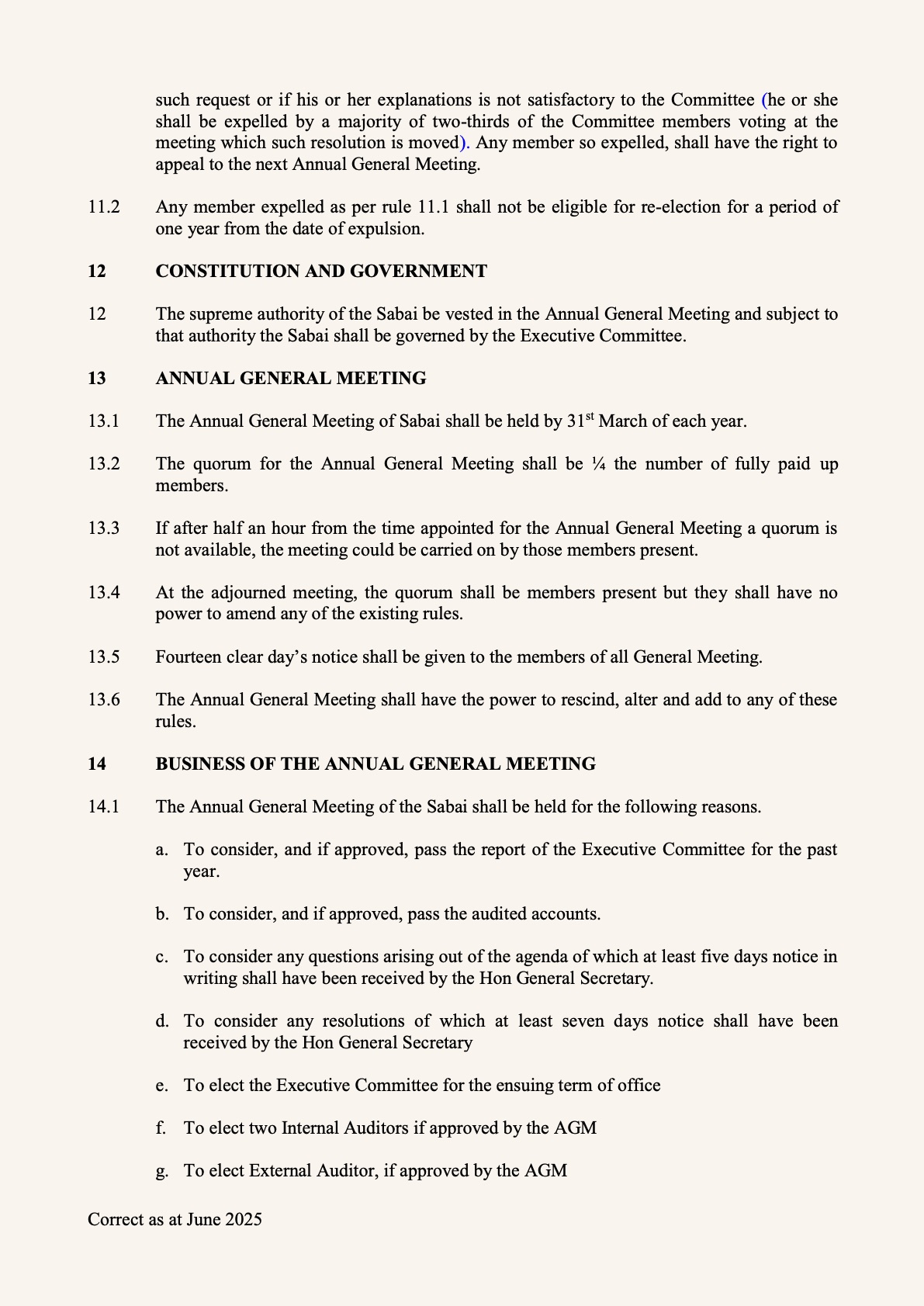
A member three months in arrears is notified, and ceases to be a member if the arrears are not paid within thirty days of that notice; they may be readmitted on paying the arrears in full. Resignation is by written notice to the Hon. General Secretary, with all dues settled. A member whose conduct the committee considers prejudicial to the Sabai may be asked to resign or to explain, and may be expelled by a two-thirds majority of the committee members voting — with a right of appeal to the next Annual General Meeting.
Rules 12–16. General meetings
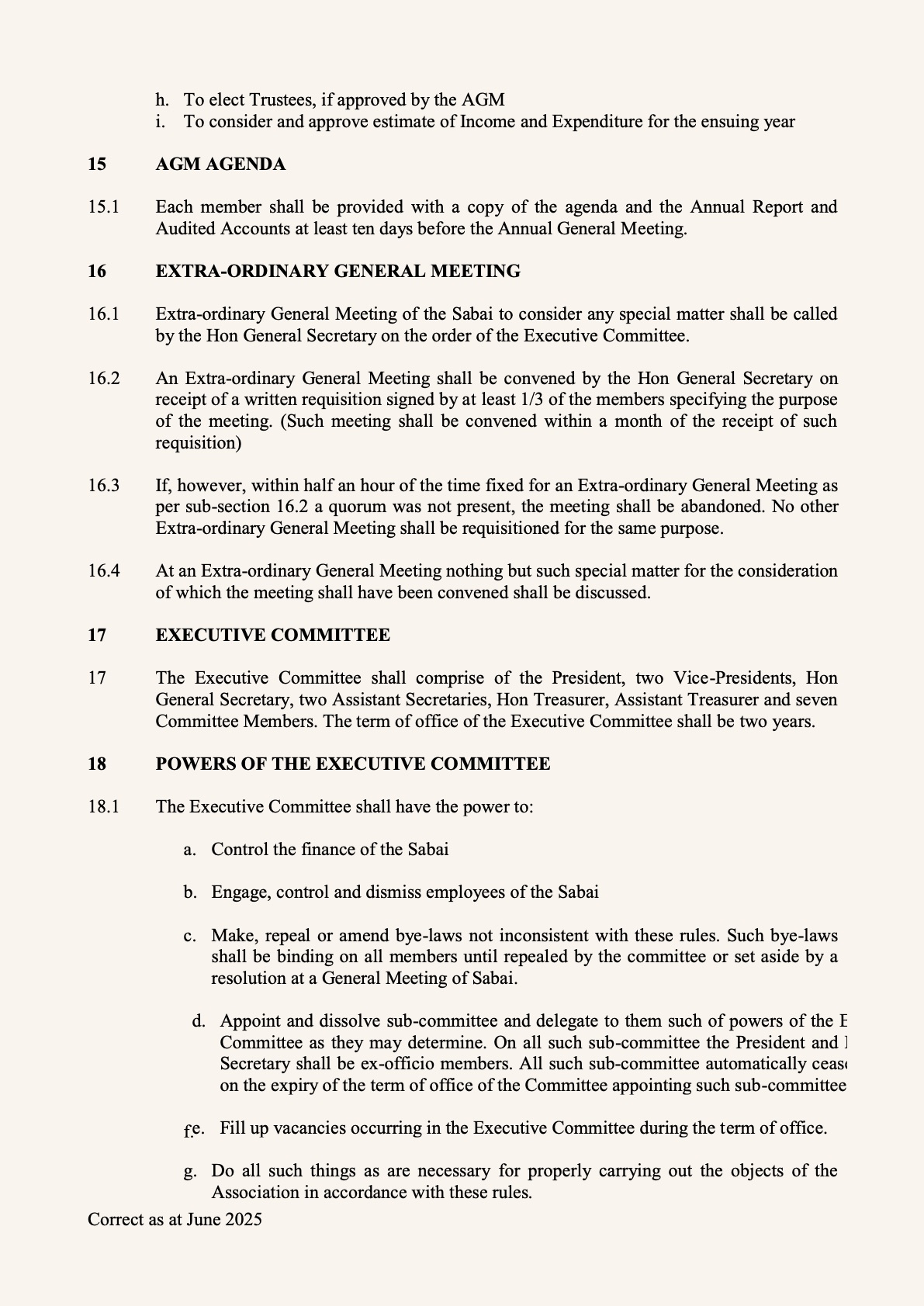
Supreme authority rests with the Annual General Meeting, which must be held by 31 March each year on fourteen clear days' notice. The quorum is one quarter of fully paid-up members; if it is not met within half an hour the meeting may proceed with those present, but an adjourned meeting has no power to amend the rules. The AGM receives the committee's report and the audited accounts, considers questions given five days' notice and resolutions given seven, and elects the committee, the internal auditors and any trustees. An Extraordinary General Meeting may be called by the committee, or on the written requisition of a third of the members.
Rules 17–22. The Executive Committee
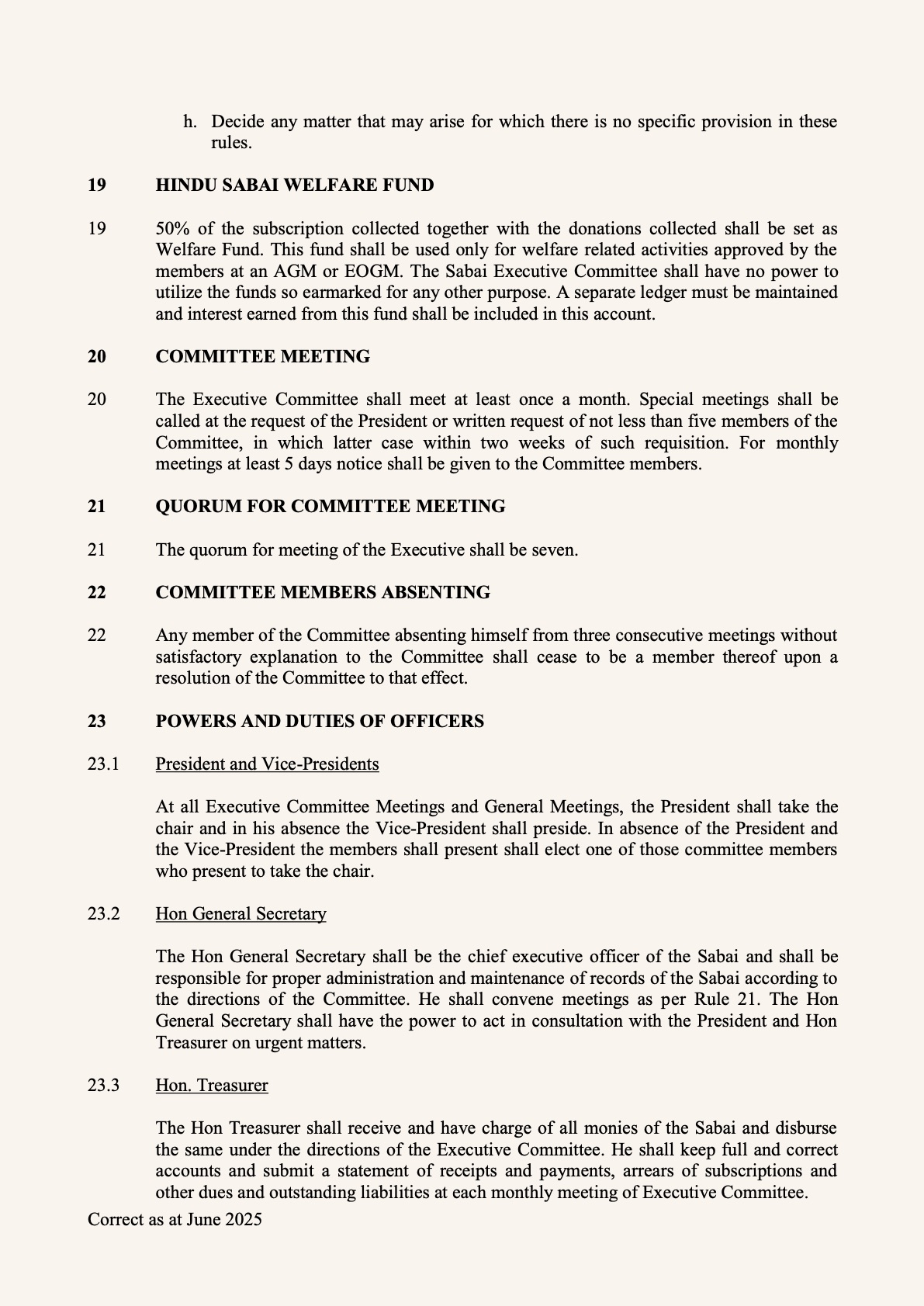
The committee comprises a President, two Vice-Presidents, a Hon. General Secretary, two Assistant Secretaries, a Hon. Treasurer, an Assistant Treasurer and seven Committee Members, for a term of two years. It controls the Sabai's finances, may make bye-laws not inconsistent with these rules, may appoint and dissolve sub-committees, and may fill vacancies arising in its own number. It is required to meet at least once a month; the quorum is seven. A member absent from three consecutive meetings without satisfactory explanation ceases to sit on it.
Rules 19. The Welfare Fund
Half of all subscriptions collected, together with donations, is set aside as a Welfare Fund. It may be used only for welfare activities approved by the members at a general meeting; the Executive Committee has no power to spend it on anything else. A separate ledger is kept, and interest earned on the fund stays in it.
Rules 23–26. Officers, accounts and audit
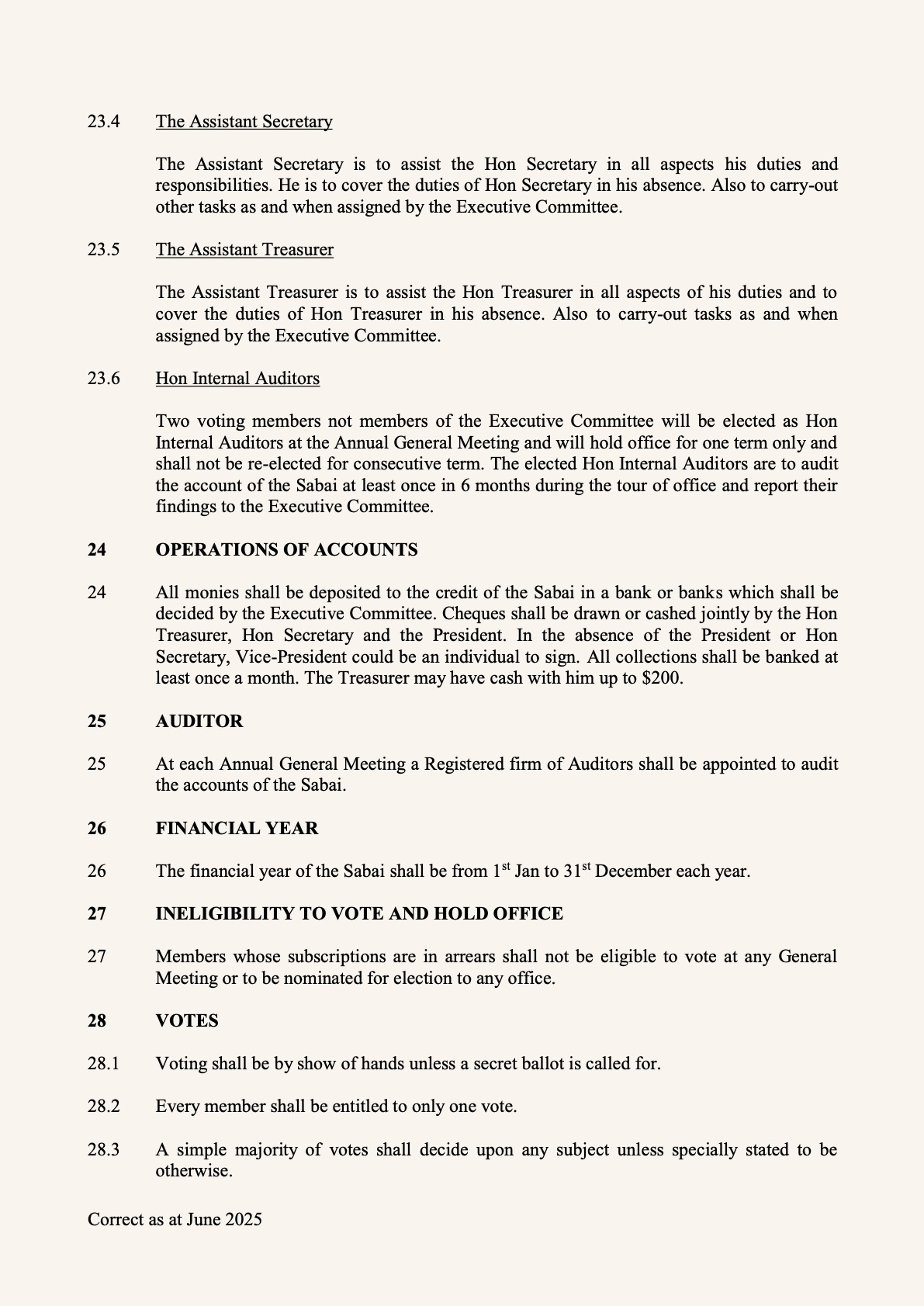
The President chairs all meetings. The Hon. General Secretary is the chief executive officer, responsible for administration and records. The Hon. Treasurer holds and disburses all monies and reports to each monthly meeting, and may hold no more than $200 in cash. Cheques are drawn jointly by the Hon. Treasurer, the Hon. Secretary and the President. Collections are banked at least monthly. The financial year runs from 1 January to 31 December.
Rules 27–29. Voting and trustees
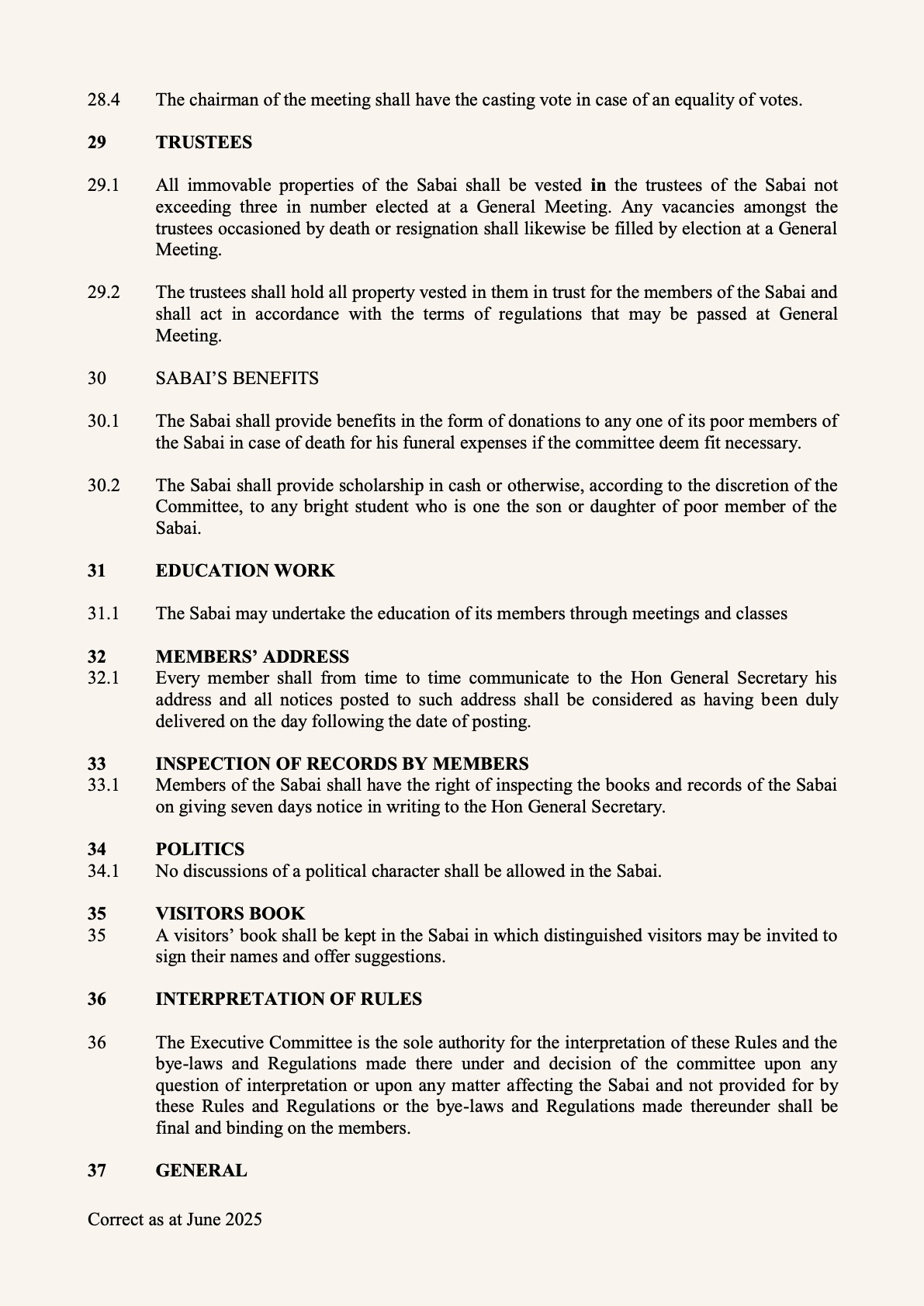
A member in arrears may neither vote nor stand for office. Voting is by show of hands unless a secret ballot is called for; every member has one vote; a simple majority decides, and the chairman holds the casting vote in the event of a tie. Immovable property is vested in up to three trustees elected at a general meeting, who hold it in trust for the members.
Rules 30–31. Benefits and education
The Sabai may donate towards the funeral expenses of a poor member on the committee's judgement, and may provide a scholarship, in cash or otherwise, to a bright student who is the son or daughter of a poor member. It may also undertake the education of its members through meetings and classes.
Rules 32–37. Records, conduct and general
Members must keep the Hon. General Secretary informed of their address. Any member may inspect the Sabai's books and records on seven days' written notice. No discussion of a political character is allowed. No money or article is received without an official receipt, and no collection may be made in the Sabai's name without the committee's permission. The Sabai's funds may not be used to pay any member's court fines. The Executive Committee is the sole authority for the interpretation of these rules.
Rules 38–40. Amendment, language and dissolution
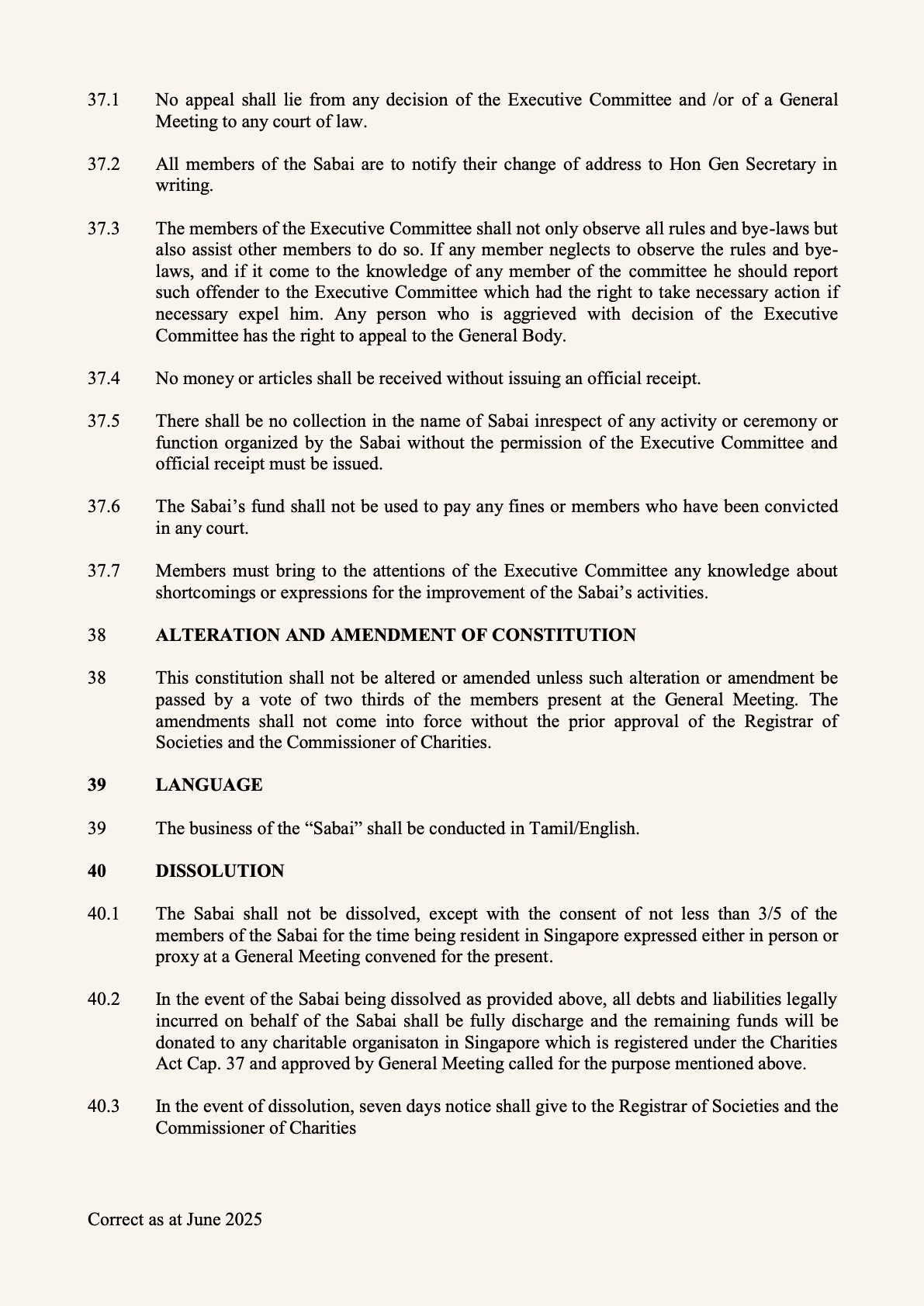
The constitution may be altered only by a two-thirds vote of the members present at a general meeting, and no amendment takes effect without the prior approval of the Registrar of Societies and the Commissioner of Charities. The business of the Sabai is conducted in Tamil and English. The Sabai may be dissolved only with the consent of at least three-fifths of its members resident in Singapore; on dissolution, debts are discharged and any remaining funds go to a registered Singapore charity approved by that meeting.
The document
The Rules and Bye-laws as filed. Every rule summarised on this page is set out in full below.
The Sabai's documents and media are published for reading and viewing on this site. They are not offered for download, and may not be reproduced or redistributed without the committee's permission.